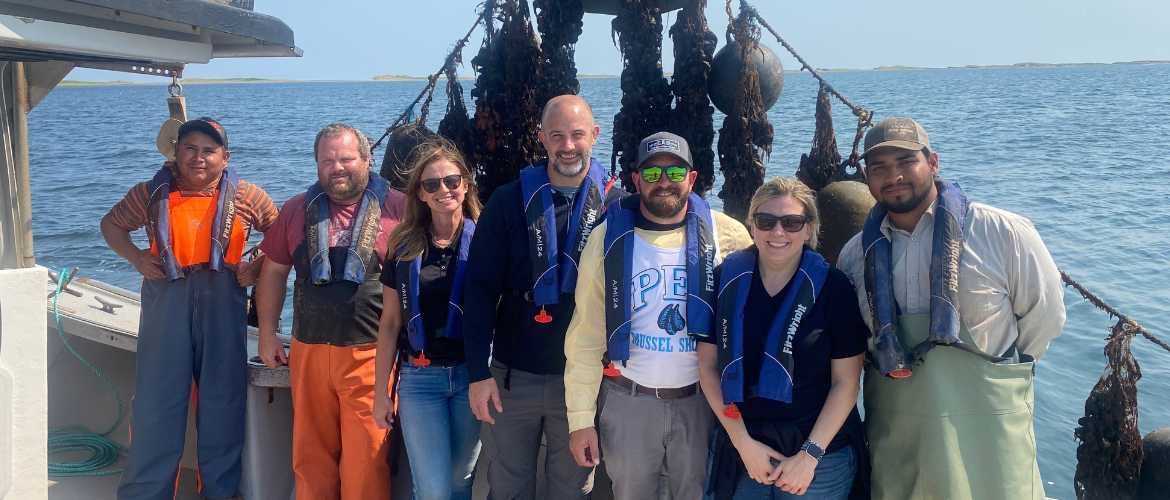
Fortune is proud to partner with Atlantic Aqua Farms, the top supplier of live, Prince Edward Island mussels in North America. Prince Edward Island, Canada sits in the Gulf of St. Lawrence, just off the coast of Nova Scotia, separated by the Northumberland Strait. The cold and nutrient-rich waters support slow, steady growth and help develop the firm, succulent texture and clean flavor that is the hallmark of PEI mussels. We source oysters and mussels from the good folks at AAF, and this summer we sent MJ Gimbar, Shannon Yaeger, and Steve Scola to learn about their 35+ years as leaders in cultivating premium shellfish. Steve is the fifth generation of the Scola family from a Sicilian fishing village that eventually founded the company that became Boston Sword & Tuna.
"I’ve been with Boston Sword & Tuna for more than 12 years and have worked in several different areas of the company. More recently I’ve taken on purchasing shellfish and have quickly developed a real appreciation for the category." - Steve Scola
Cold-Water Quality & Certifications
Atlantic Aqua Farms grows blue mussels (Mytilus edulis) in an area that is regularly inspected as part of the Canadian Shellfish Sanitation Program, ensuring coastal waters are clean and the mussels are free of any toxins. They focus on vertically integrated aquaculture; sustainability and traceability produce beautiful, consistently sized mussels.
"Atlantic Aqua Farms gave us what I can only describe as a masterclass in shellfish aquaculture and hospitality. Their generosity with their time and knowledge was incredible, and the education we received on the trip was world class. I went into the trip as a buyer and came home with a much deeper appreciation for the people, time and work behind the product we’re selling." - Steve
In 2013, AAF was the first mussel company to be certified for BAP (Best Aquaculture Practices), by Global Aquaculture Alliance, and today their farming sites are certified organic, and Ocean Wise recommended. Monterey Bay Aquarium’s seafood guidance specifically recommends farmed mussels and other farmed bivalves as ocean-friendly choices.
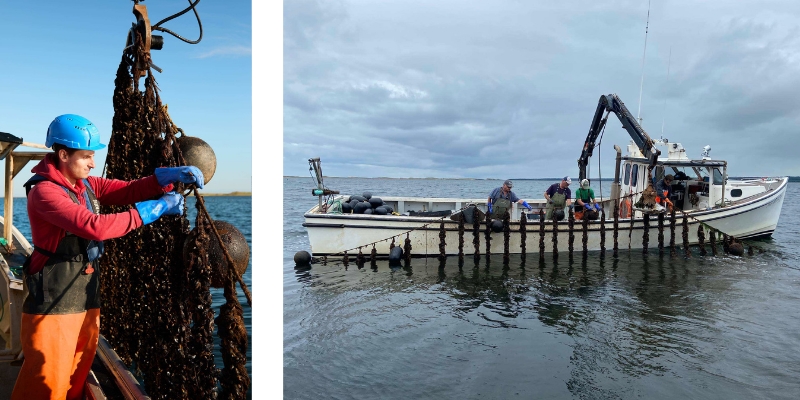
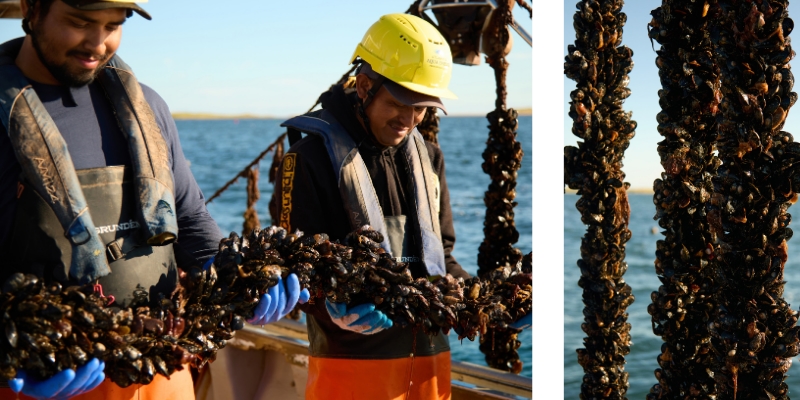
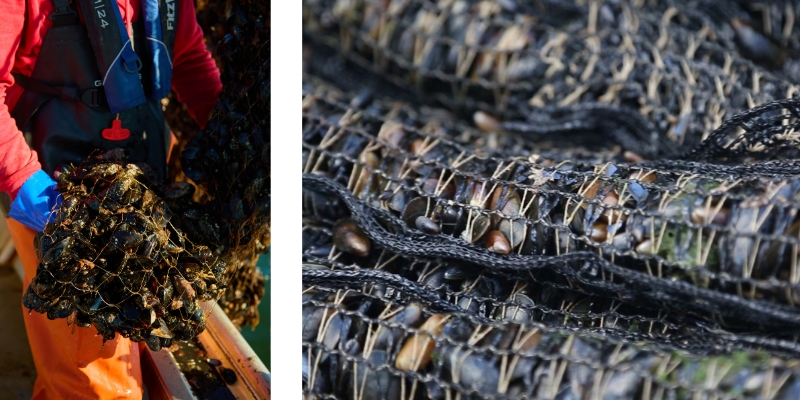
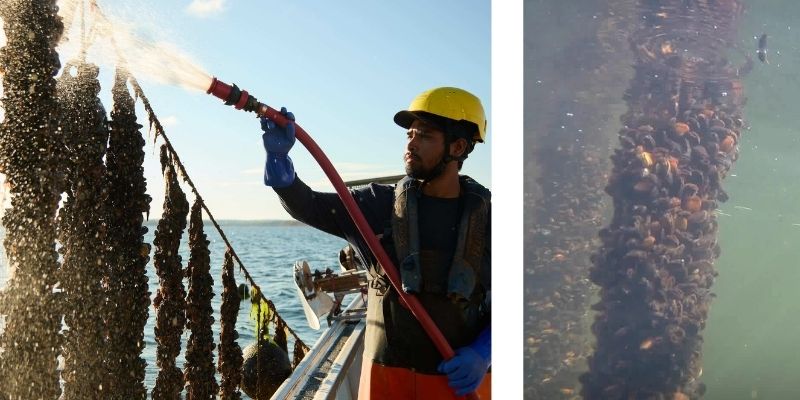
Mussels are cultivated in mesh “socks"—woven nylon netting which initially holds the mussels together and later serves as an anchor for the byssal threads, AKA, the beard. These bundles of extracellular collagenous fibers are secreted by mussels to attach to rocks, docks, or other substrates. The socks hang off a backline (long-line) in the water column, allowing the suspended mussels to continuously feed in the ceaseless current. It takes 18-24 months for mussels to reach a market size of about 2.5 inches. Unlike many proteins, farmed bivalves such as mussels do not require manufactured feed. They grow by filtering naturally occurring phytoplankton from the water.
“One of the things I found fascinating was how simple and natural the growing process is. Mussels feed naturally from the water around them while filtering that water as part of the feeding process. Seeing that firsthand gave me an even greater appreciation for why farmed mussels are considered such a sustainable seafood choice. - Steve
During the grow out process, the lines are checked periodically, giving harvesters an opportunity to check progress and, if necessary, thin out the mussels. When this attention to detail is combined with the inherent benefits of the rope-grow-out method, the resulting mussels possess a level of consistency that is second to none.
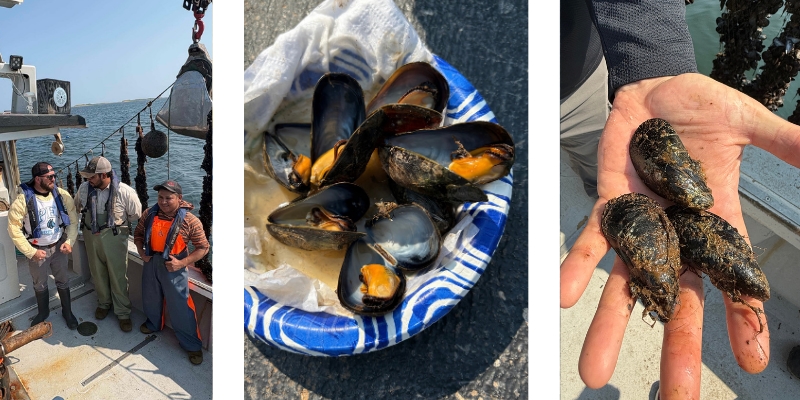
"One of the highlights was pulling mussels right off the rope ourselves, cleaning them up a little, and microwaving them right on the boat. Nothing fancy—just the mussels with a paper towel dipped in salt water. Honestly, they were some of the best-tasting mussels we had on the entire trip." - Steve
Upon harvest, the backline is hooked to a winch, lifted out of the water, and the socks are hauled on board the boat, removed from the long line, loaded into large totes, and brought ashore. The totes are then loaded onto a flatbed trailer and immediately brought to the AAF processing facility. Live mussels are processed with care and gentle handling to ensure they are not stressed.
"The amount of work and care that goes into growing mussels to market size was incredible to see firsthand. They’re handled and cared for many times throughout the growing process before they ever leave the bays." - Steve
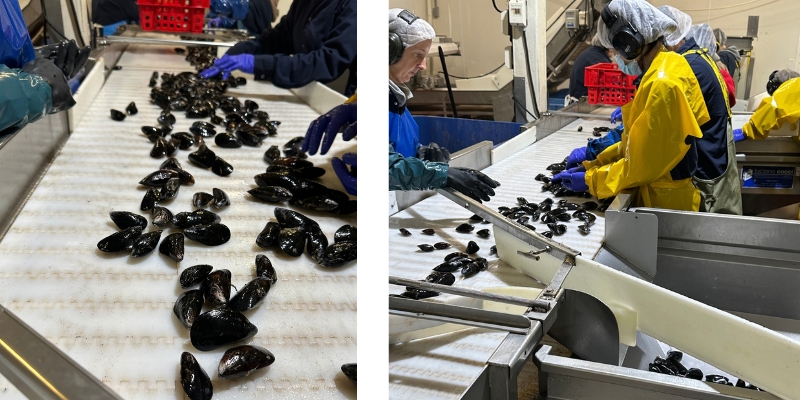
All the machinery for processing was custom manufactured for AAF to maximize efficiency and produce clean shellfish. After the mussels have been removed from the sock, they go through a pre-wash, are then gently tumbled to remove anything that might have accumulated on the shells. The mussels are then put into totes and transferred to a live holding system where they are flushed with a constant flow of chilled seawater. This step effectively flushes any sand or grit out, while simultaneously strengthening and hydrating the mussels. Then the mussels go through a de-clumping process, where a series of spindles separates them from one another; de-bearding is next, then grading. Mussels are quality checked before packing, to ensure they arrive clean, uniform in size, and pot ready.
"Seeing the entire process firsthand gave me a completely different appreciation for what goes into producing a clean, consistent, pot-ready product. AAF puts a tremendous amount of work into producing a clean, uniform product before it ever reaches us. For chefs and seafood counters, 'pot ready' means the majority of the work has already been done. The mussels have already been cleaned, de-clumped, de-bearded, graded, and quality checked before they’re packed." - Steve
Watch some highlights from their visit.
|